
Wednesday, November 21, 2018

Thursday, November 15, 2018

Wednesday, November 14, 2018

Cheesy Jokes and Serious Thoughts About Thanksgiving

The above joke is probably my favorite cheesy joke of all time.
Why did the Pilgrims eat turkey on Thanksgiving? The couldn't fit the moose in the oven.
If April showers bring May flowers, what do May flowers bring? Pilgrims.
 What's the best way to stuff a turkey? Take him out for pizza and ice cream.
What did the turkey say to the hunter? Quack! Quack! Quack!
Teacher: Where did the Pilgrims come from? Student: Their parents, of course.
 What kind of music did the Pilgrims play?
Plymouth Rock and Roll.
Q: Why did they let the turkey join the band?
A: Because he had the drumsticks.
What do you call the dirt on a Pilgrim's hands?
Pilgrime.
What would you get if you crossed a turkey with a spooky spirit?
A poultrygeist.
What's brown and white and flies all over?
 A turkey when you carve it with a chainsaw.
How many cooks does it take to stuff a turkey?
One, but you really have to squeeze him in.
Q: What smells the best at a Thanksgiving dinner?
A: Your nose.
Why did the glutton get a traffic ticket on Thanksgiving?
He was exceeding the feed limit.
Grandma: What would you like for dessert, Joey?
Joey: Pumpkin pie!
Grandma: Pumpkin pie, what, dear? Say the magic word.
Joey: I'm sorry, Grandma. Pumpkin pie, abracadabra!

What is Math teachers favorite part of Thanksgiving dinner?
Pumpkin Pi.
Knock, knock, who's there?
Arthur.
Arthur who?
Arthur any leftovers?

What would you get if you crossed Easter and Thanksgiving?
Feaster Sunday.
What's the key to a great Thanksgiving?
A tur-key, of course.
This is my second favorite cheesy joke of all time.

If April showers bring May flowers, what do May flowers bring? Pilgrims.
 What's the best way to stuff a turkey? Take him out for pizza and ice cream.
What did the turkey say to the hunter? Quack! Quack! Quack!
Teacher: Where did the Pilgrims come from? Student: Their parents, of course.
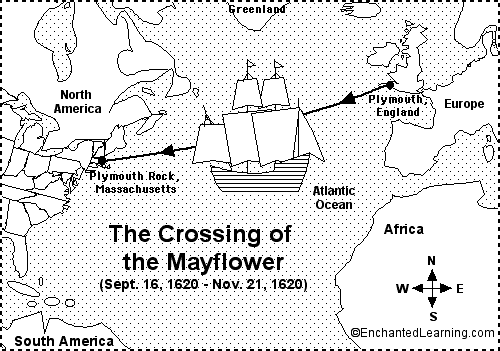
Time for a little serious talk about the Pilgrims. Let's delineate: they were not the Puritans. It was the Puritans and Henry VIII-inspired later purges that began the 'off with their head' programs that sent the Pilgrims, and groups like them, to the Netherlands, and later, to Virginia (woops, Plymouth Rock.) The Pilgrims were in search of religious freedom, and not only accepted help from the Wampanoag tribe--local Native Americans--but intermarried with them over the next few generations because so many of the Pilgrim group died the first year after they arrived in 1620. Many members of the Pilgrims left Massuchusetts during the Puritan's religious purges, like the Salem Witch Trials, and went to Rhode Island. The English have a dynamic history of religious freedom, for example, William Tyndale who translated the Bible into the English language and was martyred as a rebel. We have religious freedom now due to this legacy. Thousands of Americans have genetic ties to the Pilgrims (DNA evidence now shows) and that information is something to treasure. Now we live the liberty for ourselves and offer it to others.

Plymouth Rock and Roll.
Q: Why did they let the turkey join the band?
A: Because he had the drumsticks.
What do you call the dirt on a Pilgrim's hands?
Pilgrime.
What would you get if you crossed a turkey with a spooky spirit?
A poultrygeist.
What's brown and white and flies all over?
 A turkey when you carve it with a chainsaw.
How many cooks does it take to stuff a turkey?
One, but you really have to squeeze him in.
Q: What smells the best at a Thanksgiving dinner?
A: Your nose.
Why did the glutton get a traffic ticket on Thanksgiving?
He was exceeding the feed limit.
Grandma: What would you like for dessert, Joey?
Joey: Pumpkin pie!
Grandma: Pumpkin pie, what, dear? Say the magic word.
Joey: I'm sorry, Grandma. Pumpkin pie, abracadabra!

What is Math teachers favorite part of Thanksgiving dinner?
Pumpkin Pi.
Knock, knock, who's there?
Arthur.
Arthur who?
Arthur any leftovers?

What would you get if you crossed Easter and Thanksgiving?
Feaster Sunday.
What's the key to a great Thanksgiving?
A tur-key, of course.
This is my second favorite cheesy joke of all time.

Tuesday, November 13, 2018
Point of View-Writing a Novel

POV: Point of View
https://www.youtube.com/watch?v=SKi56cPUSFk
Peter narrating his own life (HQ)
https://www.youtube.com/watch?v=6gnezI2hOXA&list=PLz5RuqWifD5UXxeJ0eTBah0d372R31WgA

Friday, November 9, 2018
Writing a Novel In MzT's Class at VVCS (Victor Valley Christian School)

Writing
a Novel
In
Ms. Taylor’s English Class
November
2018
Purpose: The purpose of writing a novel during
November in class is to allow students the opportunity to use imagination,
writing skills, and share camaraderie in the writing experience. The quick pace of the experience is to create writing flow
rather than technical expertise.
Requirements: Students are not required to join the NaNoWriMo site to write
during the month of November in class; parental permission is required to join.
Students are required to use their assigned VVCS email. Administration and the
classroom teacher maintains access to all student writing for Ms. Taylor’s
class on school Chromebooks. Student work will be printed out every week for
assessment. Students may write at home under the supervision of their parents.
Specifications: Students will write their novel according to the standards of
VVCS, that is, encouraging Biblical guidelines and morals. No violence, no
sexual situations (implicit or explicit), or explicit or implied considerations
of choices opposed to Biblical standards of marriage are allowed. In other
words, the stories will be appropriate to age and rated G or PG.
Assessment: Students will receive points toward their English grade in
Writing Strategies. Stories will be evaluated by completion of plot from rising
action to climax to falling action and resolution; the creation of at least one
complex character that changes and learns during the story; effective use of
dialogue to advance the characterization and move the plot; a setting that
presents an effective environment for the characters; and a recognizable theme
for the story reflecting appropriate life lessons according to scripture.
Stories will be word processed on the format of the Chromebook.
This
activity will last from Thursday, November 1 to Friday, November 30, until the
end of the student’s English Class, and emailed to Ms. Taylor.
Tuesday, November 6, 2018
Academic Vocabulary

Academic Vocabulary is defined as words that are traditionally used in academic dialogue and text. Specifically, it refers to words that are not necessarily common or frequently encountered in informal conversation.
Academic Vocabulary
https://www.spellingcity.com/academic-vocabulary.html
The Top 60 Most Common Academic Words
Writing Dialogue

Dialogue in Creative Writing
Rules for Punctuating Dialogue
Writing Dialogue: 10 Tips to Help You
Monday, November 5, 2018


What's Happening in MzT's Classroom Week of 11/5-11/9 2018

NaNoWriMo
https://nanowrimo.org/dashboard

This week's focus on Writing Strategies is characterization.
Outside Reading is going into hyperdrive-- SSR every day, daily logging in pages read, taking ownership of their reading--Alternative Book reports! Reading Comprehension is the name of the game.
The Seniors are reading Macbeth-oops, I guess I should say, "The Scottish Play," and as we read, watch Patrick Stewart's 2010 version. And read aloud and write, write, write.

Sunday, November 4, 2018

Subscribe to:
Posts (Atom)